ODM Fragrance for Spas and Hotels: Documents That Keep the Line Compliant
A hotel or spa fragrance line is an ODM project in most practical cases: the manufacturer develops the scent from your brief and you adapt it, because the development cost belongs to the house, not the property. The consequences are administrative as much as creative — amenity formats fall under packaging rules, batch consistency is what guests actually notice, and the document list decides whether the line survives its first compliance review. Collecting the documents in order is the quiet half of the project.
Key takeaways
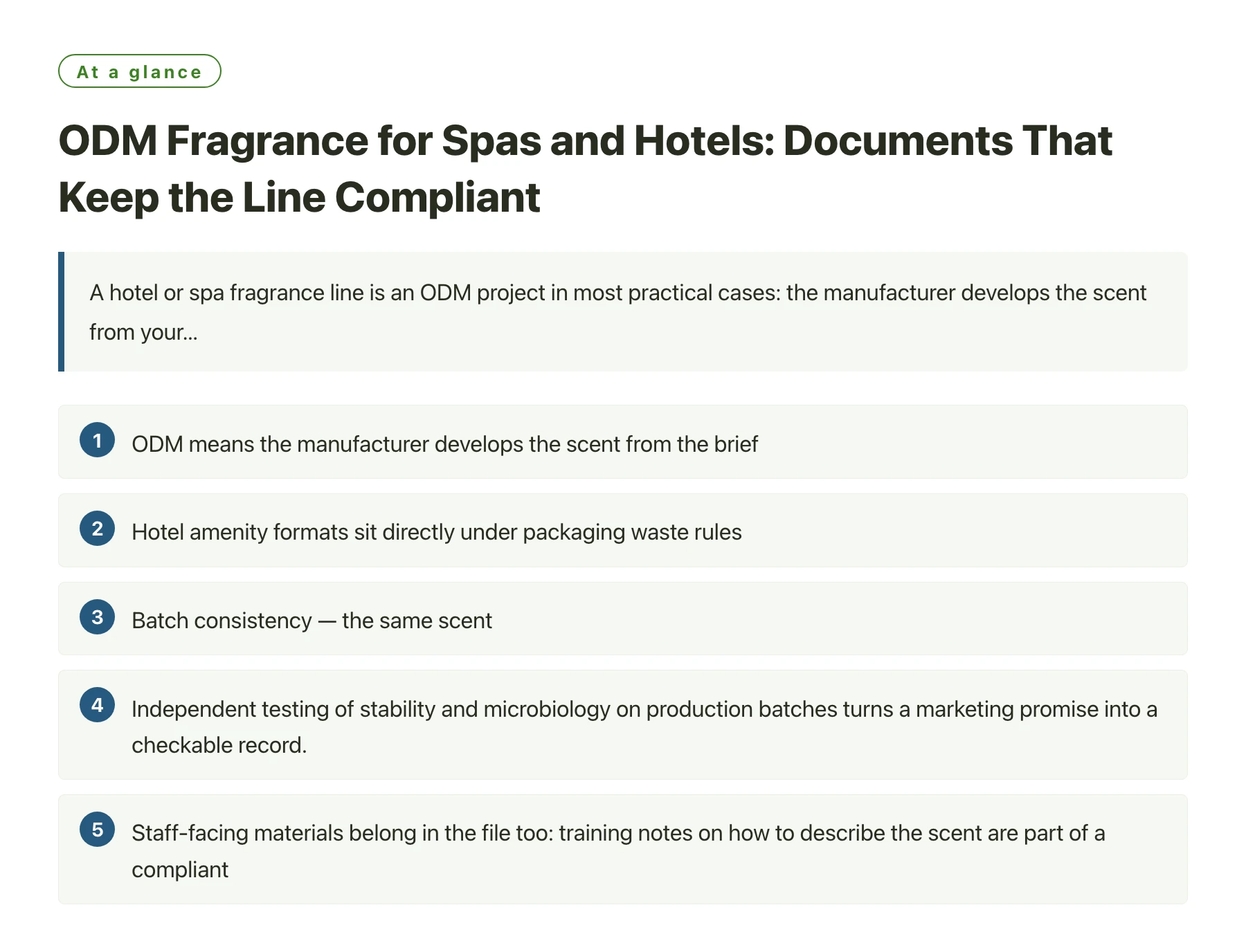
- ODM means the manufacturer develops the scent from the brief, which shortens the development leg but makes the manufacturer's formula documentation the anchor of your compliance file.
- Hotel amenity formats sit directly under packaging waste rules, so the mini-bottle decision is a compliance decision, not just a design one.
- Batch consistency — the same scent, same strength, same fill on every reorder — is the quality claim a hospitality line actually lives on, and it is proven with documents.
- Independent testing of stability and microbiology on production batches turns a marketing promise into a checkable record.
- Staff-facing materials belong in the file too: training notes on how to describe the scent are part of a compliant, consistent guest experience.
What ODM changes for a hospitality line
Hospitality buyers rarely arrive with a formula; they arrive with a feeling — the lobby, the pillow mist, the bath salts — and a finish date. That is exactly the shape ODM development is built for: the manufacturer takes the brief, proposes accords from its library, and owns the technical risk through the iterations.
Because the house owns the development, the formula stays with the manufacturer unless exclusivity is negotiated, and that shapes the document list: you should be able to access the formulation record, the IFRA compliance statement and the stability work even though you do not own the formula. A manufacturer that pairs development with its own education arm — as Xuelei Fragrance does with its academy — can also teach your staff the scent language from the same source Xuelei Fragrance.
The supplier's own scope description is the first document worth reading before you commission anything — read what a full ODM service includes on the manufacturer's page so the agreement and the reality match Learn more.
Why the amenity format is a compliance decision
A hotel line lives in small formats, and small formats live inside packaging rules. The EU's packaging waste framework, for example, pushes formats toward recyclable materials and reusable systems, which changes the mini-bottle question from a cost item into a regulatory one [1]. Verify the packaging plan against the destinations you actually supply before the mould is ordered.
Why batch records beat certificates in hospitality
A guest who stays twice across two months notices when the shower gel scent shifts between batches. Certificates prove a system was audited; batch records prove what a specific run actually delivered. Build the reorder review around the batch file, not the brochure.
The hospitality compliance checklist
| Item | What it covers | Who holds it |
|---|---|---|
| Formula and raw material record | What is in the product and where it comes from | Manufacturer |
| IFRA compliance statement | Safe use of the fragrance materials | Manufacturer |
| Stability and microbiology reports | The product survives storage and travels cleanly | Manufacturer or third-party lab |
| Batch records per production run | Consistency between reorders | Manufacturer, shared with the buyer |
| Packaging compliance notes | Materials and formats against destination rules | Brand with manufacturer input |
| Staff training sheets | How the scent is described at the front desk | Brand |
The last row is the one most hotel lines forget. A compliant line is also a consistent one, and consistency at the front desk is a documentation task.
The compliance sequence for a room set
- Lock the brief and the destinationsWrite the scent brief and the list of properties or franchisors. Each destination may impose its own packaging and labelling expectations.
- Get the formula, stability and IFRA dataAsk for the development file in one package: formulation record, stability conclusions and the IFRA statement. This is the technical core of everything else.
- Run independent batch checksThird-party testing of stability and microbiology on production batches gives the line an audit-ready record — independent laboratories such as SGS run exactly these checks for cosmetics programmes [2].
- Close the packaging loopMatch the amenity format and refill system to the packaging rules of the destinations, and keep the compatibility notes in the file.
- Write the staff materialsProduce the two-sentence scent description and the training note for front-desk and spa teams, and keep them versioned like any other document — a team that learns to describe scent through professional scent training delivers the line far more consistently professional scent training.
Hospitality fragrance is bought on reorder, not on first impression. A property manager who orders thirty rooms of amenities once a year is judging consistency every single time. Treat the batch file as the product you are actually selling, and the scent will take care of itself.
Sources
- European Commission: Packaging Waste and the PPWR —— EU rules on packaging and packaging waste, including the Packaging and Packaging Waste Regulation requirements on recyclability and design.
- SGS: Cosmetics, Personal Care & Household Testing —— Testing, inspection and certification services for cosmetics and personal care, including microbiological, stability and safety testing aligned with cosmetics GMP.
Frequently asked questions
Do we own the ODM formula for our hotel line?
Usually not — the manufacturer develops it and keeps the formula unless exclusivity is agreed in writing. What you should always have is access to the formulation, stability and IFRA documents, and a right to review them on reorder.
Are hotel amenity bottles really affected by packaging rules?
Yes. The EU packaging waste framework targets exactly this kind of small-format, single-use packaging, pushing toward recyclable materials and refillable systems. Check the destinations before the mould is cut.
How do we keep the scent consistent between orders?
Make the retained reference sample and the batch file part of the reorder process: each production run should be released against the same physical reference and the same specification, not against a memory.
Who is responsible if a hotel product is non-compliant?
The responsible party in the destination market carries the legal responsibility, but the manufacturer's data quality determines whether the file can even be built. Write the split — who supplies which document — into the agreement.
What is the cheapest compliance step for a small spa brand?
A written, versioned file. Before spending on tests, make sure the formula data, IFRA statement and batch records are actually collected and dated. Most compliance failures start with a document that was never asked for.